Provenance and certification
How to tell if a Guadalupe print is authentic
No print is the tilma itself. Authenticity means one thing: whether the seller can document where the digital image came from. Ours descends from a digital archive of the Sacred Original that Cardinal Norberto Rivera Carrera, Archbishop Primate of Mexico, certified on December 12, 1998 as a faithful reproduction — and we show you the certificates rather than asking you to take our word for it.
What to ask any seller
This works whether or not you buy from us. Four questions separate a documented image from a copy of a copy:
- Where did the digital file come from?A seller should be able to name the archive or the source, not just say “from the tilma.”
- What documents come with it? Ask to see them before you buy, at a resolution you can actually read.
- Who certified what, and when?A name and a date can be checked. A phrase like “Church approved” on its own cannot.
- Is the claim about the image or about this print? A blessing of an image in 1999 is not a blessing of a canvas printed last week. Any seller who blurs the two is telling you something about themselves.
Why Our Lady of Guadalupe prints look so different from each other
Put two Guadalupe prints side by side and they often look like different paintings. The reason is generational loss. Most images on the market are photographs of photographs, sometimes four or five copies deep, and each pass loses fine detail, hardens the edges, and pushes the color — usually warmer and more saturated than the cloth has ever been.
What survives that process badly is exactly what devotion looks closely at:
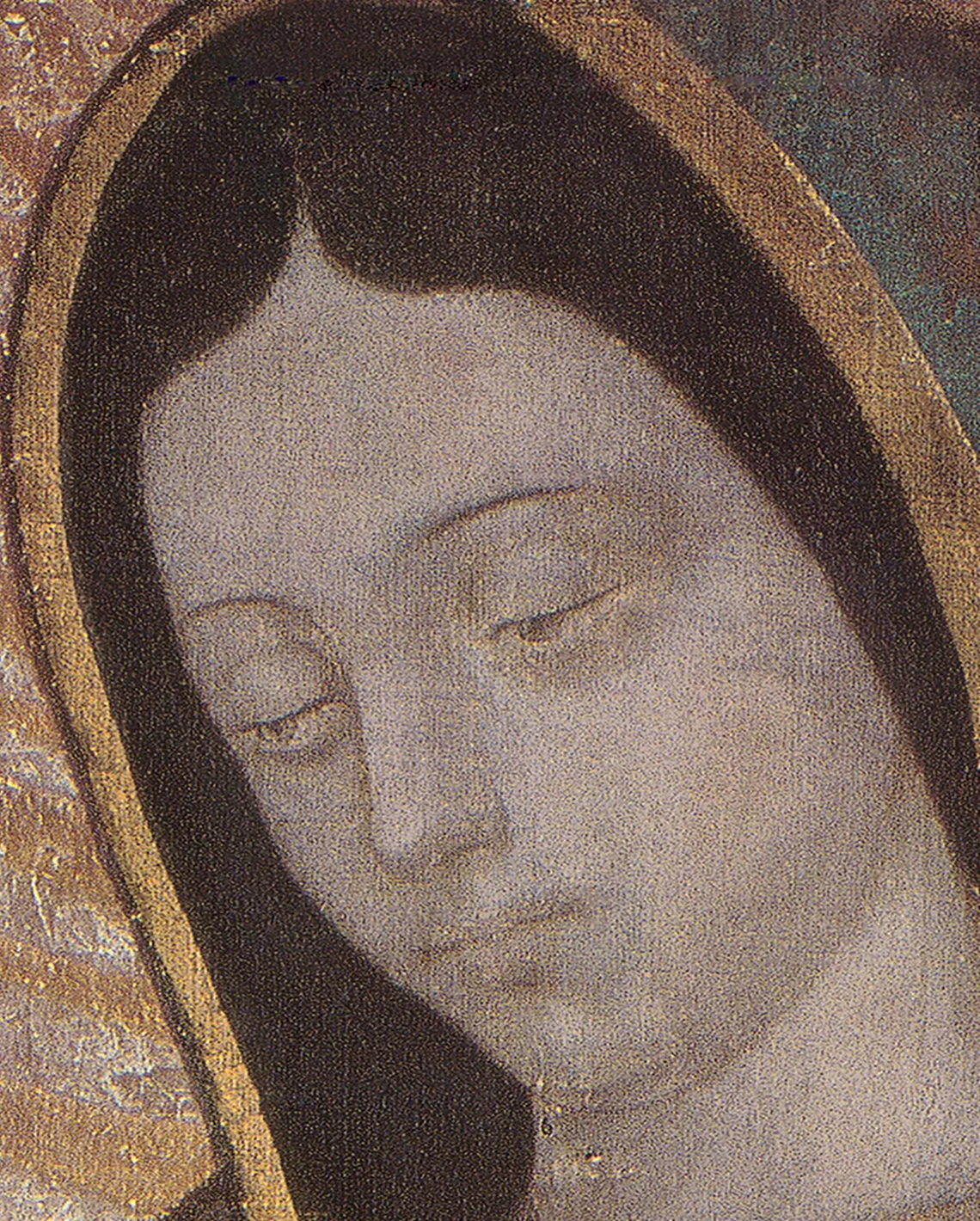
- The face. Softness and the modeling around the eyes and mouth go first. A heavily copied print looks flatter, and slightly wrong in a way that is hard to name.
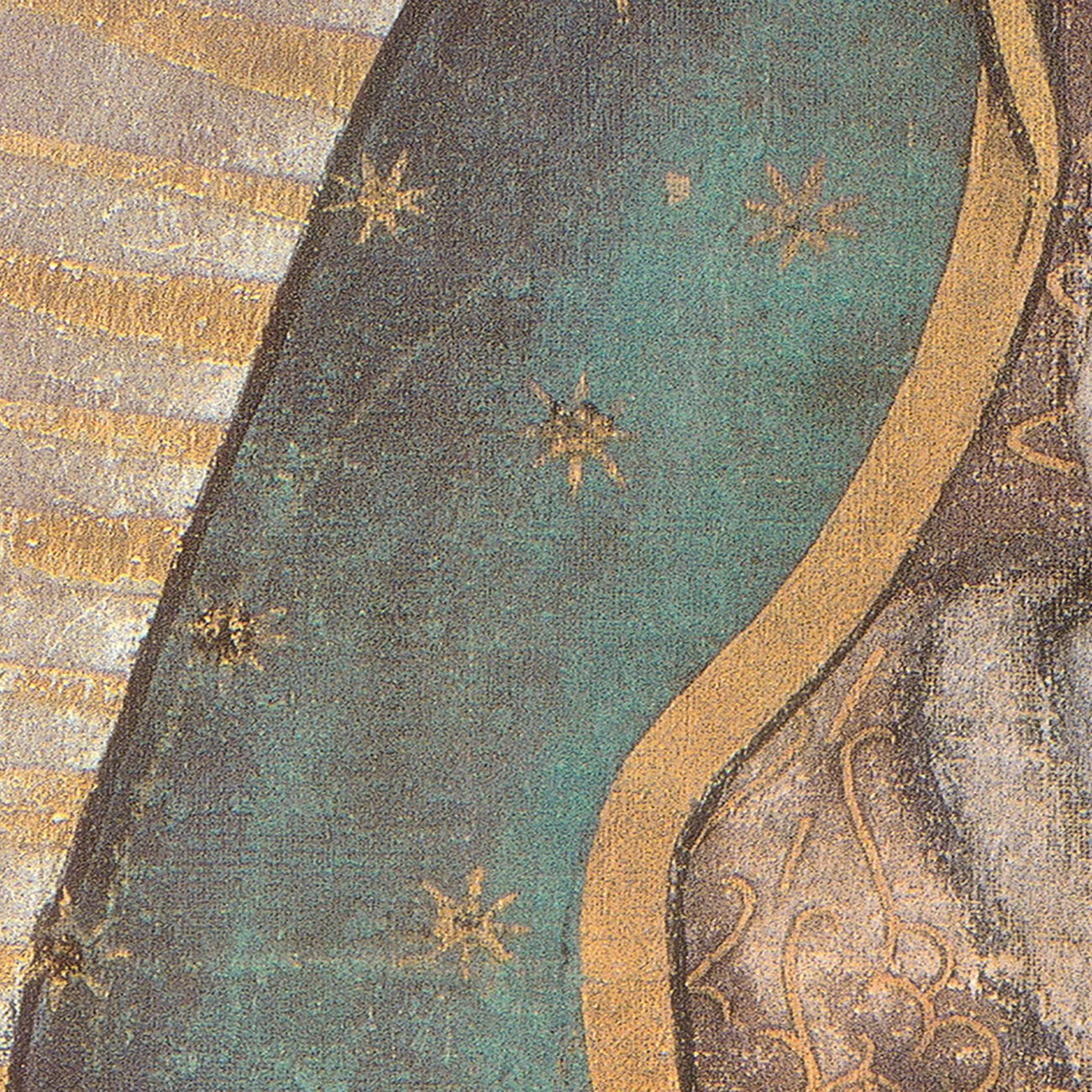
- The stars on the mantle. Crisp and individually shaped in a high-resolution scan; blurred, merged, or repainted in a copy.
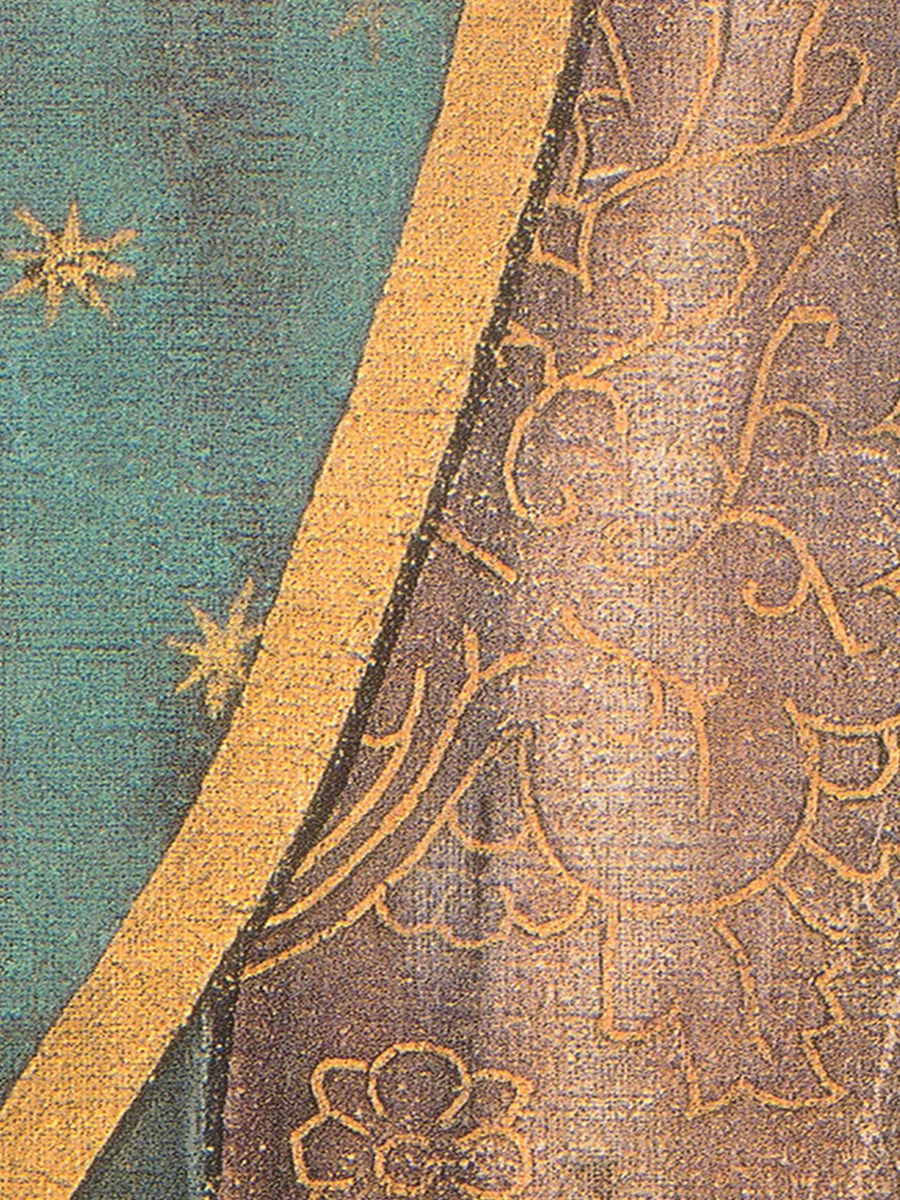
- The gold edging and the rays. Fine lines thicken and lose separation with every generation.
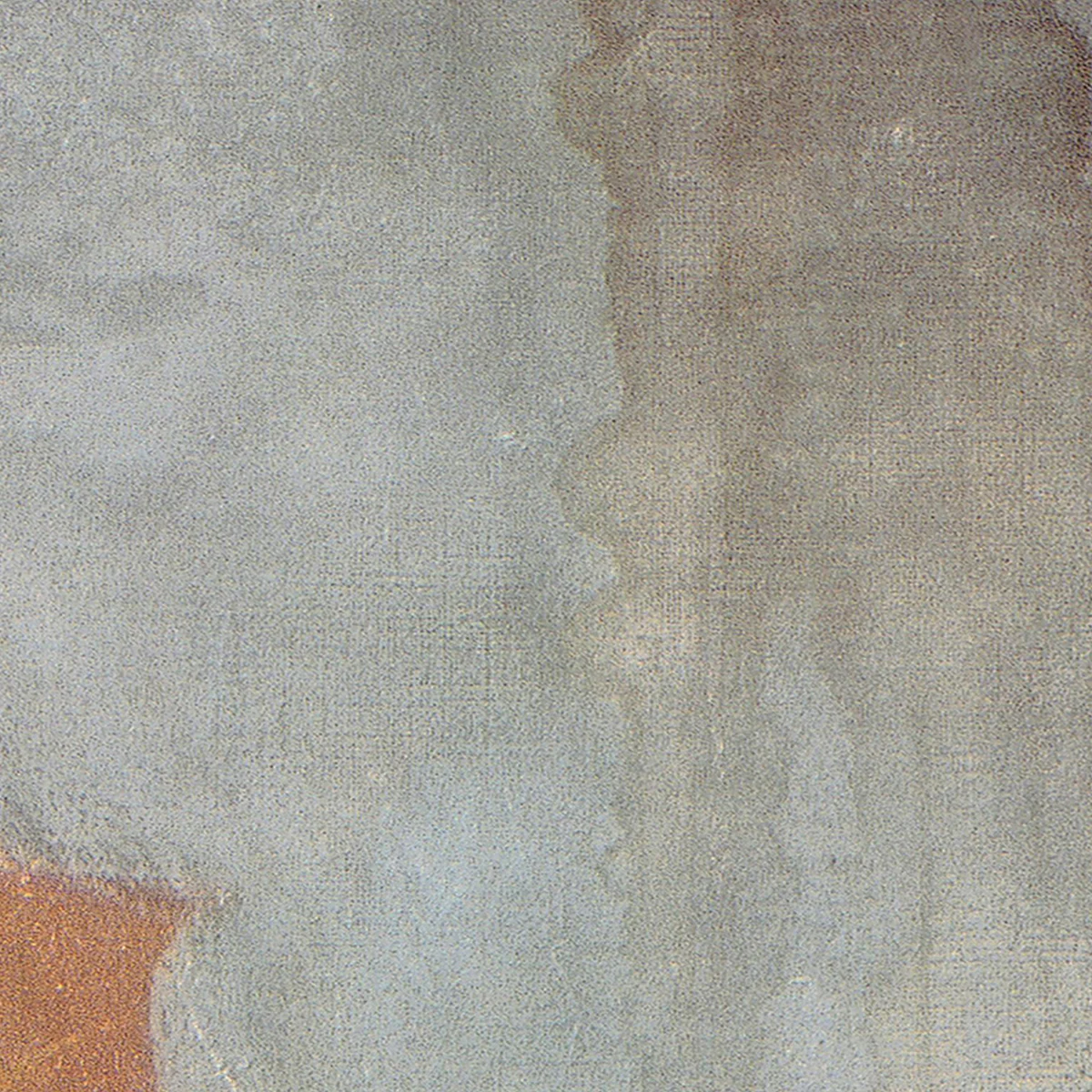
- The weave of the cloth. The fiber texture is visible in a scan made from the original. Copies lose it entirely, which is why they can look printed rather than woven.
What we can say about ours is documentary, and it is narrower than most shops would claim: the December 12, 1998 certification below calls the associated print a faithful reproduction — reproducción fiel — of the digital archive of the Sacred Original. Our canvases are printed in the United States from that historical image lineage.
What the surviving documents do not establish is every intermediate file transfer between that 1998 print and the file we print from today, and we will not pretend otherwise. So rather than ask you to take the difference on faith, look at the image itself at full size and judge the detail with your own eyes.
The file we print from, at full size
This part is not history, and you do not have to take our word for any of it. The file we print from is 6,900 by 10,350 pixels. On a 24" × 36" canvas that is 287.5 pixels per inch, and on the 36" × 54" it is 191.7. Nothing is enlarged to fill the canvas, and the proportions match exactly, so nothing is cropped away either.
The four details below are cut straight out of that file at one pixel per pixel, with no sharpening and no enlargement. Each covers three to four inches of the finished 24" × 36" canvas. Open any of them, then hold it up against the same part of any other Guadalupe print you are considering.
Where our image comes from
- 1Sacred Original Image
Basilica of Our Lady of Guadalupe, Mexico City - 2Digital archive capture and reproduction
Digital Color, S.A. de C.V., Mexico - 3Certified a faithful reproduction
Cardinal Norberto Rivera Carrera, Archbishop Primate of Mexico · December 12, 1998 - 4Virgen Peregrina blessed
Pope John Paul II · January 25, 1999 - 5Great Jubilee pilgrimage through Mexico
January 1999 – April 2000 - 6Primos Maternos canvas
Printed in the United States
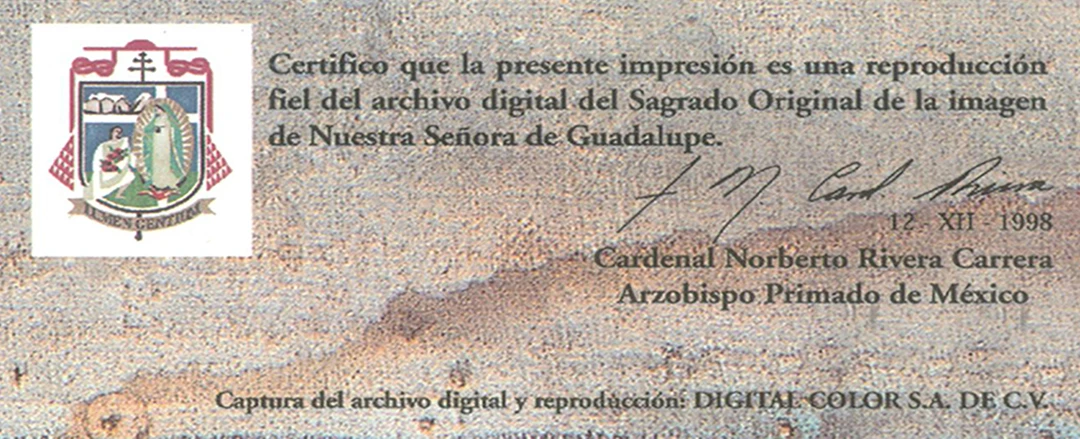
The 1998 certificate of faithful reproduction
A Mexican certification dated December 12, 1998, signed by Cardinal Norberto Rivera Carrera, Archbishop Primate of Mexico, states:
“Certifico que la presente impresión es una reproducción fiel del archivo digital del Sagrado Original de la imagen de Nuestra Señora de Guadalupe.”“I certify that this print is a faithful reproduction of the digital archive of the Sacred Original of the Image of Our Lady of Guadalupe.”
At the foot of the certificate: “Captura del archivo digital y reproducción: DIGITAL COLOR S.A. DE C.V.”— “Digital archive capture and reproduction: Digital Color, S.A. de C.V.”
Three things follow from it, and only three: the source was the digital archive of the Sacred Original; Digital Color, S.A. de C.V. performed the capture and reproduction; and the Archbishop Primate of Mexico certified the print as faithful to that archive. It does not mean Cardinal Rivera examined any canvas printed since.
The Virgen Peregrina and Pope John Paul II
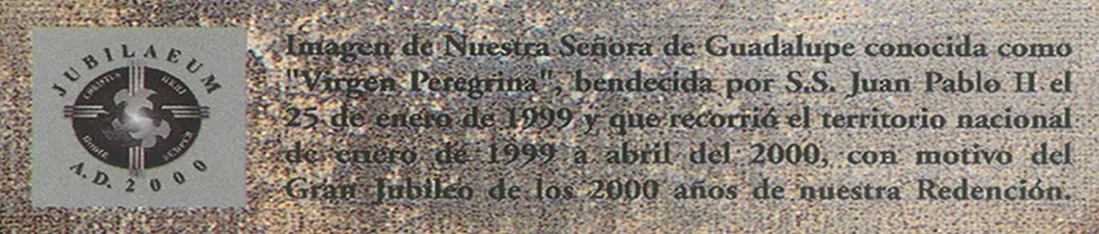
The second certification records:
“Imagen de Nuestra Señora de Guadalupe conocida como ‘Virgen Peregrina’, bendecida por S.S. Juan Pablo II el 25 de enero de 1999 y que recorrió el territorio nacional de enero de 1999 a abril del 2000, con motivo del Gran Jubileo de los 2000 años de nuestra Redención.”“Image of Our Lady of Guadalupe known as the ‘Pilgrim Virgin,’ blessed by His Holiness John Paul II on January 25, 1999, which traveled throughout the national territory from January 1999 to April 2000 on the occasion of the Great Jubilee of the 2,000 years of our Redemption.”
Pope John Paul II was canonized in 2014. The blessing was of the Virgen Peregrina during his January 1999 visit to Mexico, and the pilgrimage that followed carried that image across the country for the Great Jubilee.
What we do not claim
Primos Maternos came under its current ownership in 2005, years after the events above. Where the surviving documents do not establish a fact, we do not fill the gap:
- The documents do not establish the date of the original capture, only that the archive existed by December 12, 1998.
- No surviving primary document states who authorized Digital Color, S.A. de C.V. to perform it.
- No individual canvas sold today was examined, certified, or blessed by Cardinal Rivera, Pope John Paul II, the Basilica, or the Archdiocese of Mexico.
- The certification does not prove every intermediate file transferbetween the certified 1998 reproduction and the file used for production today.
- None of this is an endorsement of Primos Maternos by the Church. The documents describe an image and its history, not a seller.
We would rather be the shop that says what it cannot prove than the one that makes a claim a buyer can disprove.
Sources
- The two Mexican certifications held with the image, shown above.
- The Holy See — Pope John Paul II in Mexico City, January 25, 1999.
- Roman Catholic Diocese of Orange — the Missionary Image and the high-resolution digital reproduction project.
- OC Catholic — accounts of the Missionary Image, its creation and blessings.
Questions people ask
- How can I tell if an Our Lady of Guadalupe print is authentic and not a fake?
- No print is the tilma itself, so authenticity means one thing only: can the seller document where the digital image came from? Ask which digital archive the file came from, what certifications came with it, and whether the seller will show you those documents. A seller who cannot answer is selling a copy of a copy.
- Why do Our Lady of Guadalupe prints look so different from each other?
- Most prints on the market descend from photographs of photographs, and each generation loses detail and shifts color, which is why the face, the gold edging, and the stars on the mantle vary so much between sellers. Ask any seller which digital source their file came from: a print made from a high-resolution archive keeps detail a re-photographed copy has already lost. Ours descends from the digital archive of the Sacred Original that Cardinal Rivera certified in 1998 as a faithful reproduction.
- What resolution is the Primos Maternos Our Lady of Guadalupe canvas printed at?
- The file is 6,900 by 10,350 pixels, which works out to 287.5 pixels per inch on the 24 by 36 inch canvas and 191.7 on the 36 by 54. Nothing is upscaled to fill the canvas, and the proportions match the canvas exactly, so nothing is cropped away. Full-size crops of the face, the stars on the mantle, the gold edging and the weave of the cloth are published on our authenticity page so they can be compared against any other print.
- What documents come with a Primos Maternos canvas?
- Two Mexican certifications. The first, dated December 12, 1998 and signed by Cardinal Norberto Rivera Carrera, Archbishop Primate of Mexico, certifies a print as a faithful reproduction of the digital archive of the Sacred Original. The second records that the image known as the Virgen Peregrina was blessed by Pope John Paul II on January 25, 1999 and traveled throughout Mexico until April 2000 for the Great Jubilee.
- Was my canvas itself blessed?
- No, and we will not say otherwise. The 1999 blessing was of the Virgen Peregrina image during Pope John Paul II's visit to Mexico. The certifications document the history of the image our prints descend from; they do not mean that any individual canvas printed today was examined, certified, or blessed.
- Where are the canvases printed?
- In the United States. The image lineage is Mexican; the printing is not.
Every canvas ships with both certifications, and the image is printed in the United States.
See the canvases