What Science Cannot Explain About the Tilma
A cactus-fiber cloak that should have crumbled in twenty years has lasted nearly five hundred. Nobel chemists, NASA scientists, and ophthalmologists have all tried — and failed — to explain it.
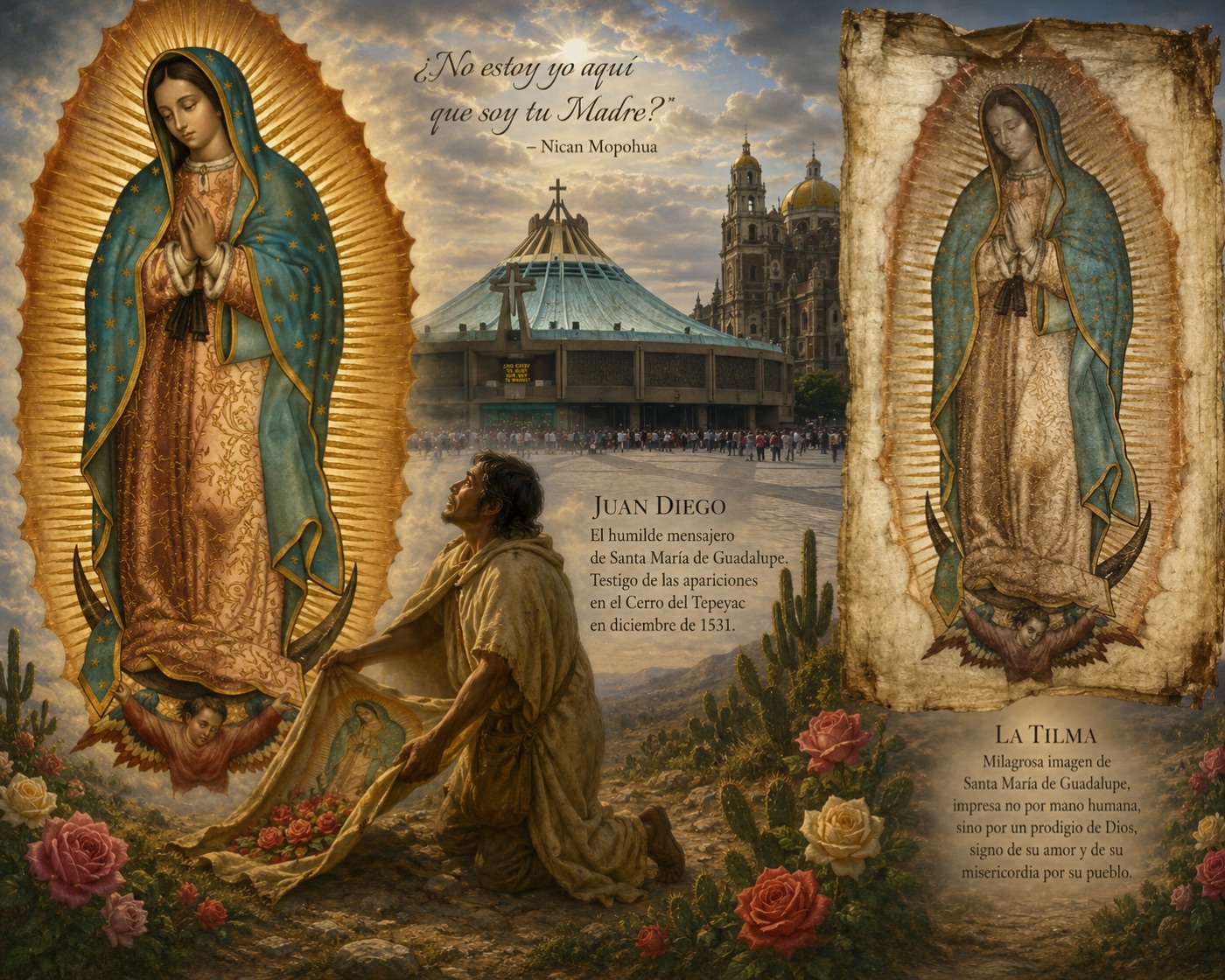
The tilma is a rough cloak woven from the fibers of the maguey cactus. It measures about 5'7" by 3'5" — two pieces of coarse agave cloth stitched up the center. Aztec men wore them as everyday clothing in 1531. Nothing about the material is precious.
Cloth woven from this fiber breaks down within roughly twenty years. Juan Diego's tilma has now hung in Mexico City for almost five centuries — much of that time exposed to candle smoke, humidity, dust, salt air, the breath of millions of pilgrims, and the constant touching of hands. It still shows no sign of decay.
The pigments that aren't there
In 1936, the German chemist Richard Kuhn — a Nobel laureate — examined threads from the tilma and reported that the colors were not animal, not mineral, and not vegetable. There was no known pigment that matched them.
In 1979, two Americans — biophysicist Philip Callahan of the University of Florida (himself a painter) and Jody B. Smith — examined the image with infrared photography. Their findings, summarized:
- No trace of paint anywhere on the original portions
- No brush strokes
- No sketches, no underdrawing, no corrections
- No primer or sizing on the cloth
- Face, hands, robe, and mantle were laid down in a single step
A NASA professor who studied the infrared analysis wrote:
"There is no way to explain the quality of the pigments used for the pink dress, the blue veil, the face and the hands, or the permanence of the colors, or the vividness of the colors after several centuries, during which they ordinarily should have deteriorated… Studying this Image has been the most moving experience of my life."
Callahan and Smith also noted iridescence — the image changes color slightly with the viewing angle, a property that cannot be reproduced by any technique of human painting.
The figures in her eyes
In 1929, the Basilica's official photographer noticed what looked like a bearded man reflected in the right eye of the image. In 1951, that same figure was confirmed by examination through a magnifier, and the same reflection was found in the left eye — in the position it would appear in a living human eye, according to the optical laws of the Samson-Purkinje effect (the triple reflection produced by the curved surface of a real cornea).
More than twenty ophthalmologists have since examined the eyes. The first, Dr. Javier Torroella Bueno in 1956, certified the presence of the full triple reflection. Dr. Rafael Torrija Lavoignet, examining with an ophthalmoscope, noted that the eyes appeared strangely "alive."
In 1979, Dr. José Aste Tonsmann — a Cornell-trained engineer working at IBM — scanned a high-resolution photograph of the eyes at 2,500× magnification and processed the images with the same algorithms used for satellite imagery. He identified thirteen separate human figures reflected in the eyes, in the proportions and positions you would expect in a real eye reflecting what stood in front of it:
- A seated indigenous man
- An elderly white man with a bald patch and white beard — matching contemporary portraits of Bishop Zumárraga
- A young translator
- Juan Diego, opening his tilma
- A black woman (Zumárraga's freed slave Maria, documented in his will)
- A pensive bearded Spaniard
- And, in the center of the pupils — a family group: a young mother with a baby on her back in a rebozo, a man, two children, and an older couple
In 1991, ophthalmologists detected microscopic capillary circulation in the free edge of the eyelids and cornea. The pupils have been shown to constrict in response to light and dilate again when it is removed — exactly as a living human eye would.
What the tilma has survived
In 1791, a workman cleaning the glass frame spilled concentrated nitric acid directly onto the cloth. Such a spill should have eaten a hole through the fabric within minutes. Instead, only a faint streaking appeared in one corner — and over time even that has faded.
In 1921, during the Mexican Revolution, a bomb hidden in a vase of flowers at the foot of the image was detonated. The blast destroyed the marble altar steps, bent a brass crucifix, and shattered windows in nearby buildings. The pane of glass protecting the tilma was not even cracked. The image was untouched. Since 1993 the tilma has hung behind bulletproof glass.
What it cost the scientists
Many of the researchers who studied the image came to it as skeptics and left it as believers. The NASA scientist's quote above was not isolated. Callahan, an established academic with no religious motive for his conclusions, wrote that the original image was "unexplainable as a human work."
We don't ask anyone to take any of this on faith. We ask only that you look at the image, with the science laid out, and decide for yourself what to make of it.
Bring the tilma image into your home or chapel.
Browse the collection →Printed from the 1998 Rivera Carrera–certified digital archive · canvas printed in the USA · two Mexican certifications with every order · free U.S. shipping