A Codex in the Image: What the Aztecs Read
To the Spanish, it was a portrait. To the Aztecs, every fold, star, and color spoke. Inside the picture is a complete message written in two cultures at once.
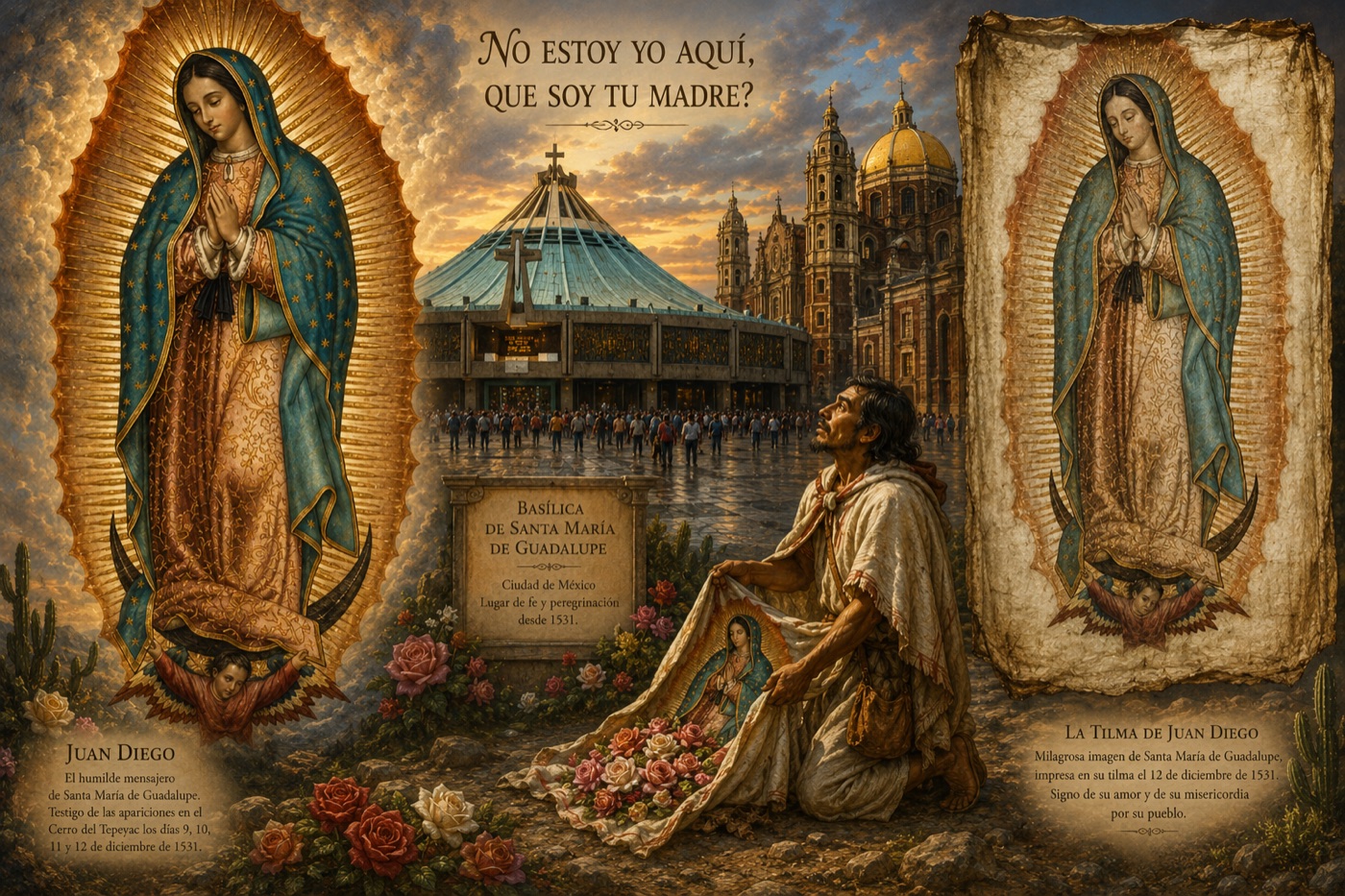
The Spanish missionaries had been preaching in Mexico for ten years before the apparition. Their results were thin. Aztec religion was sophisticated, ancient, and woven into every part of daily life. No sermon — and no theology lesson in a language the indigenous people barely understood — was going to displace it.
Then Juan Diego opened his tilma in front of the bishop. Within ten years of that morning, an estimated nine million Aztecs had been baptized. Human sacrifice — practiced annually on tens of thousands of victims — ended.
Anthropologists who study the image now understand why. To the Spanish it was a portrait of Mary. To the Aztecs it was a codex — a complete written message in a visual language they read fluently.
A face neither Spanish nor Indian
The Virgin's face is that of a young mestiza woman — the first generation of Spanish-Indian intermarriage. In 1531 there were no adult mestizos. The image was anticipating, by a generation, a new people who would be rejected by both sides. The face says: you will belong to me.
The signs of a pregnant virgin
In Aztec culture, a woman's hair told her status. Loose hair meant unmarried. A center part meant a virgin. Untied hair meant pregnant. The Virgin of Guadalupe wears her hair untied — but with a part in the middle. To an Aztec, this was unmistakable: a pregnant virgin.
The high black sash around her waist was the Aztec maternity belt. The ends of the bow signified the end of one age and the beginning of another. Just below the sash — at the exact position of the womb — is a four-petaled flower called the Nahui Ollin, the Aztec glyph for the presence of God, for divinity itself, for the center of heaven and earth.
Modern gynecologists have measured the figure's bodily proportions and confirmed they match a woman roughly nine months pregnant. A physician once placed a stethoscope on the cloth below the sash and reported a steady rhythm of 115 beats per minute — the heart rate of a fetus in utero. The fabric maintains a constant temperature of 98.6° F.
The stars on her mantle
The blue-green mantle was the color of royalty, reserved in Aztec culture for the highest nobility. It is sprinkled with stars. In 1981, Father Mario Sánchez and Dr. Juan Hernández Illescas compared the position of those stars to the night sky over Mexico City on the winter solstice of December 12, 1531 — the moment Juan Diego opened his tilma in front of the bishop.
The match was exact. The constellations on the mantle are the constellations of that morning, in the proper relative positions:
- The Boreal Crown sits above her head
- Virgo is on her chest, near her folded hands
- Leo lies over her womb, with its bright star Regulus — "the little king"
- Gemini, the twins, falls at her knees
- Orion is positioned exactly where the angel supports her
Defeating the old gods, without a word
She stands in front of the sun, its rays radiating around her body. To the Aztecs, the sun was Huitzilopochtli — the god who demanded the blood of human sacrifice. By standing in front of it and eclipsing it, she announced a power greater than his.
She stands on a crescent moon. The moon was Tezcatlipoca, the god of night. By standing on it she announced victory over him.
Her head is bowed — and Aztec gods never bowed their heads. Their idols stared straight ahead with wide eyes to display dominance. A bowed head meant submission to a higher power. She was, the image said clearly, not a god herself but the servant of one.
Her hands are folded in prayer in the indigenous gesture of offering, not in the European gesture of supplication. One hand is darker, one lighter — the union of two races. At her throat is a gold brooch bearing a small black cross. The same cross was on the banner of Hernando Cortés. The image was telling the Indians, plainly: the faith of the conquerors is the faith I bring.
Coatlaxopeuh — "she who crushes the serpent"
Juan Bernardino, Juan Diego's uncle, said the Lady gave him her name. The Spanish heard Guadalupe, which is what stuck — but the closest Nahuatl word, almost identical in pronunciation, is coatlaxopeuh: "she who crushes the serpent."
For an Aztec hearing it, the meaning was direct. Quetzalcóatl, the feathered serpent, was one of their highest gods, and the serpent also stood for the demonic spirits demanding human sacrifice. The Lady at Tepeyac was identifying herself by the act she had come to perform.
For a Christian, it was the prophecy of Genesis 3:15 — "I will put enmity between you and the woman… She will crush your head."The image and the name carried the same message in two cultures at once.
What the image accomplished
Within a decade, the temples were emptied. The drums that had once announced human sacrifice were heard no more. Churches rose where idols had stood. Nine million people changed religions because they recognized — in a single image — a message addressed to them in their own language, by someone who clearly knew them.
Every canvas we print carries that same image. We didn't design any of it. Nothing in it was painted by human hands.
Bring the tilma image into your home or chapel.
Browse the collection →Printed from the 1998 Rivera Carrera–certified digital archive · canvas printed in the USA · two Mexican certifications with every order · free U.S. shipping