The Sign on the Tilma: How Mary Appeared to Juan Diego
Four apparitions on the hill of Tepeyac, a bed of Castilian roses on barren ground, and an image that no human hand had painted.
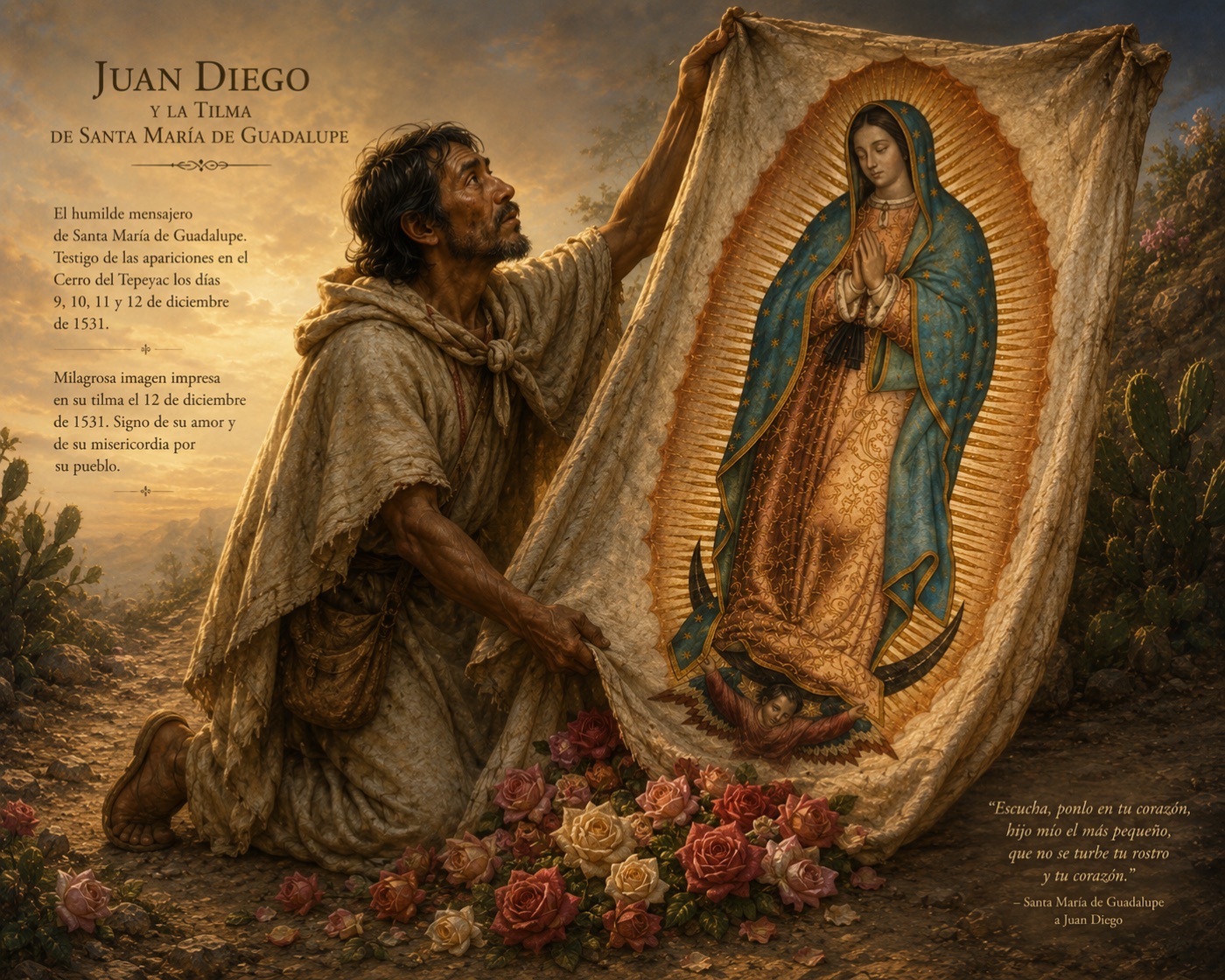
On the morning of Saturday, December 9, 1531, a 57-year-old indigenous widower named Juan Diego was walking to Mass at Tlatelolco. His path took him past the hill of Tepeyac, a few miles north of what is today Mexico City. At the foot of the hill he heard music — and a woman's voice calling his name.
She was young, perhaps eighteen. Her skin was the color of his own. She told him who she was:
"Know for certain, littlest of my sons, that I am the perfect and perpetual Virgin Mary, Mother of the True God through Whom everything lives, the Lord of all things near and far, the Master of heaven and earth."
She asked for a temple to be built on that spot, where she could "show and give all my love, compassion, help, and protection." She sent Juan Diego to the bishop of Mexico City with the request.
The bishop's doubt
Bishop Juan de Zumárraga, a Spanish Franciscan, listened politely. Juan Diego was an indigenous laborer, recently baptized, with no standing. The bishop did what any bishop in 1531 would have done — he asked for a sign.
Juan Diego returned to Tepeyac and reported the bishop's answer. The Lady told him to come back the next morning, when she would give him a sign worthy of belief.
An uncle near death
But the next morning, Juan Diego could not come. His uncle, Juan Bernardino, was dying. Juan Diego left at dawn to fetch a priest to administer the last rites — and tried to skirt the hill so he wouldn't have to face the Lady empty-handed. She intercepted him anyway.
Her words to him on that fourth and final visit have been engraved on the hearts of Mexicans for almost five centuries:
"Do not let anything afflict you, and do not be afraid of any illness or accident or pain. Am I not here who am your Mother? Are you not under my shadow and protection? Is there anything else that you need?"
She told him not to worry about his uncle — Juan Bernardino had already been healed. (When Juan Diego returned home that evening, he found him well, and his uncle told of a young Lady in light who had appeared to him and called herself "Immaculate Virgin Mary who crushed the Serpent.")
Roses in December
The Lady sent Juan Diego to the top of Tepeyac to gather flowers. Tepeyac in December was a barren rocky outcrop where nothing grew. Juan Diego climbed it anyway. At the summit he found a bed of Castilian roses — flowers not native to Mexico, and not in season anywhere — blooming in the morning frost.
He cut them and brought them down. With her own hands the Lady arranged them inside his tilma — the rough cactus-fiber cloak worn by Aztec men — and tied it around his neck. She told him:
"You are my ambassador worthy of confidence. Go in peace."
The sign
Back at the bishop's residence, Juan Diego was made to wait. When he was finally admitted, he opened his tilma to let the roses tumble out as proof — and saw the bishop and his attendants fall to their knees. On the coarse cloth of the tilma, where there had been nothing before, was an image of the Lady, life-sized, exactly as Juan Diego had seen her at Tepeyac.
That tilma is the same one still hanging today in the Basilica of Our Lady of Guadalupe in Mexico City. It is the image we print on every canvas we sell. Almost five hundred years later, no one has been able to explain how it was made.
Juan Diego spent the remaining seventeen years of his life telling the story to every Indian who would listen. In 2002, Pope John Paul II canonized him in Mexico City — the first indigenous American to be declared a saint.
Bring the tilma image into your home or chapel.
Browse the collection →Printed from the 1998 Rivera Carrera–certified digital archive · canvas printed in the USA · two Mexican certifications with every order · free U.S. shipping